This guide is independent and contains no paid placement. If affiliate links are added later, they will be clearly marked and will not change our editorial checks.
Devon works best when you commit to a trip shape: coast, moor or a quieter inland base. Trying to combine both coasts and the moors in a weekend usually creates more car time than dog time.
Coast or moor is a useful first decision
Coastal bases suit early beach walks and short sections of coast path, but parking and dog restrictions need checking. Moor-edge bases trade sea views for open-country access, though livestock and exposed weather demand a reliable lead routine. Inland parks can offer better value and calmer evenings if you are happy to drive for a beach day.
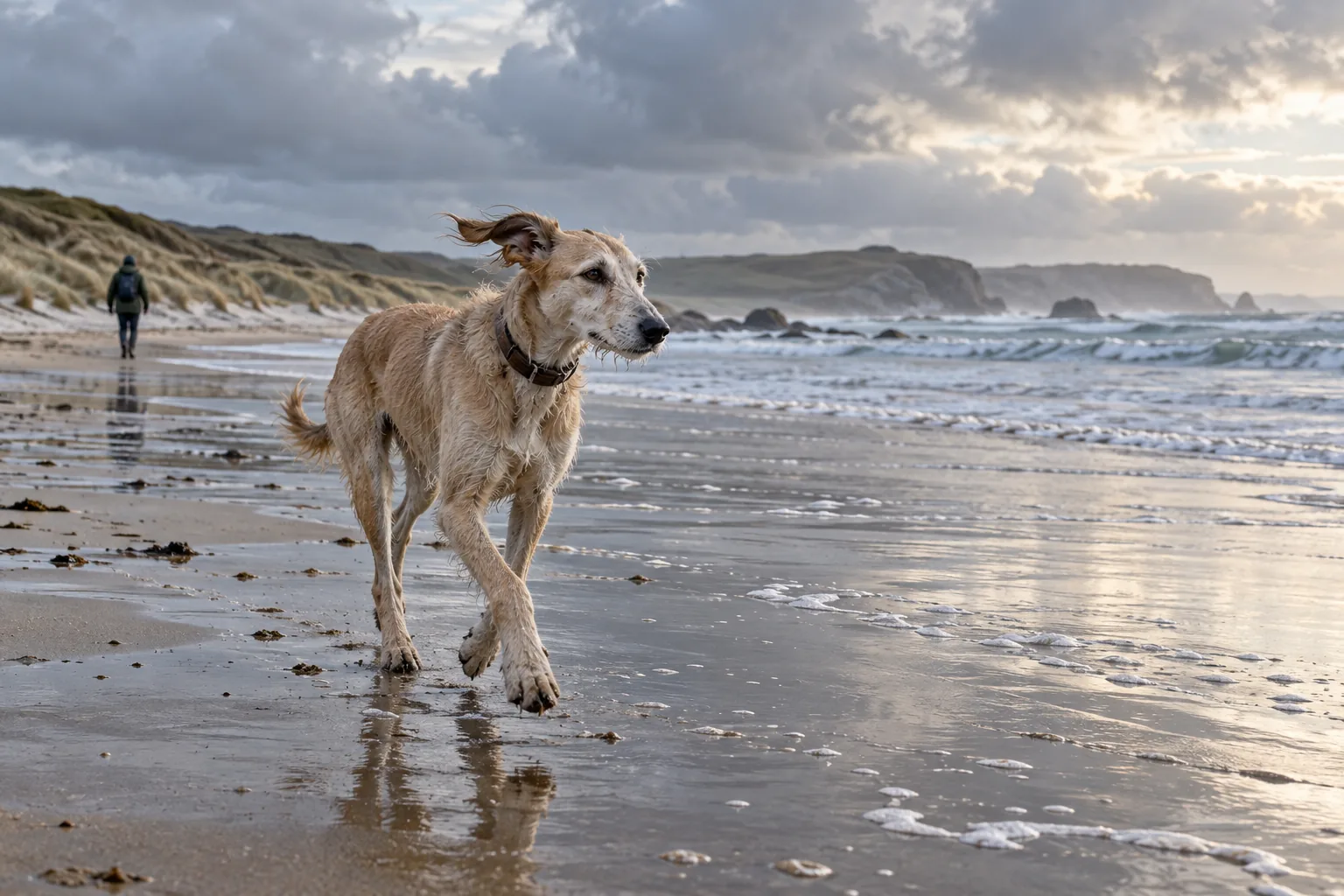
The two coasts differ in character. The north coast — surf beaches around Woolacombe, Croyde and Saunton — offers big open sands that dogs love, but the famous stretches carry seasonal dog restrictions and the area is built for summer crowds. The south coast, from the Exe estuary through the English Riviera to the South Hams, is more sheltered and village-based; beaches are smaller and often pebbly, but the walking is gentler and the pubs more numerous. Neither is universally better for dogs — choose by your dates, the restrictions in force, and how far you are willing to drive each day.
The moors are Devon’s other half. Dartmoor’s open granite country and Exmoor’s combe valleys give dogs the kind of big-sky walking that a beach cannot, but they come with livestock, exposed weather and ground that can be boggy after rain. A moor-edge park suits dogs that need space more than scenery-chasers who will spend every day in the car anyway. An inland base between the two — around Exeter, Crediton or South Molton — can be the pragmatic compromise: cheaper, calmer at night, and within reach of either landscape for a planned day out rather than a daily obligation.
Measure journeys in minutes
Devon’s lanes and summer traffic make mileage a poor planning tool. Put the park and three intended walks into a live map at the time of day you expect to travel. A stay becomes easier when at least one satisfying walk needs no car and another is less than twenty minutes away.
The M5 and A38 do the heavy lifting into the county, but the last stretch is where time disappears. Single-track lanes with passing places, summer caravans meeting tractors, and Sat-nav routes that look clever and drive terribly all add minutes that mileage never shows. Test the actual routes: park to beach, park to moor walk, park to the nearest town for supplies. If every outing starts with twenty-five minutes of lane negotiation, the dog spends the holiday waiting in the car.
Arrival timing matters as much as route. Aim to arrive in daylight — navigating unfamiliar lanes in the dark with a tired dog is avoidable stress — and on summer Saturdays expect the roads near the coast to be slow from late morning. Keep the first day’s plan minimal: settle in, walk the park boundary, and save the ambitious expedition for day two when everyone is rested.
Inspect the accommodation description
For coast days, prioritise washable floors, a covered threshold and drying space. For moor walks, ask whether ticks are common locally and carry a remover. If your dog watches every passer-by, choose a unit away from the main pedestrian route and avoid floor-to-ceiling windows facing a busy path.
Read listings forensically. “Enclosed garden” should prompt a question about fence height, gate gaps and what “enclosed” actually encloses — a low picket fence contains a view, not a terrier. Decking needs the same scrutiny: gaps between boards, drops at the edges, and whether the steps have risers a small or older dog can manage. Photographs taken in summer can hide a multitude of winter sins, so ask for the accommodation’s current condition if you are booking out of season.
Inside, the dog-relevant features are floors, space and quiet. Hard floors throughout beat carpet in the living area; a boot room or entrance porch gives a wet dog somewhere to be contained; and a unit at the park’s edge, away from the playground and the late-night bar terrace, gives a noise-sensitive dog a chance of unbroken sleep. These are the details that decide whether the week feels restful — and they are all answerable by email before you pay.
Livestock, moor and coast-path safety
Devon is working farmland as well as holiday country, and dogs meet livestock on coast paths, moorland and the lanes between. Sheep graze cliff-top fields; cattle — including cows with calves — graze parts of Dartmoor and Exmoor; ponies wander freely on the open moor. The rule is simple and non-negotiable: dogs on leads around livestock, every time, no matter how reliable the recall feels at home.
Ground-nesting birds add a seasonal layer from roughly March to July, when dogs should stay on paths and under close control on moorland and coastal heath. Adders are present but rarely seen — the practical precaution is keeping dogs out of dense bracken and rocky crevices in warm weather and knowing the route to the nearest vet. Ticks are the more routine hazard: check ears, armpits and groin after moor and long-grass walks, carry a tick remover, and talk to your vet about prevention before the trip if your dog is a tick magnet.
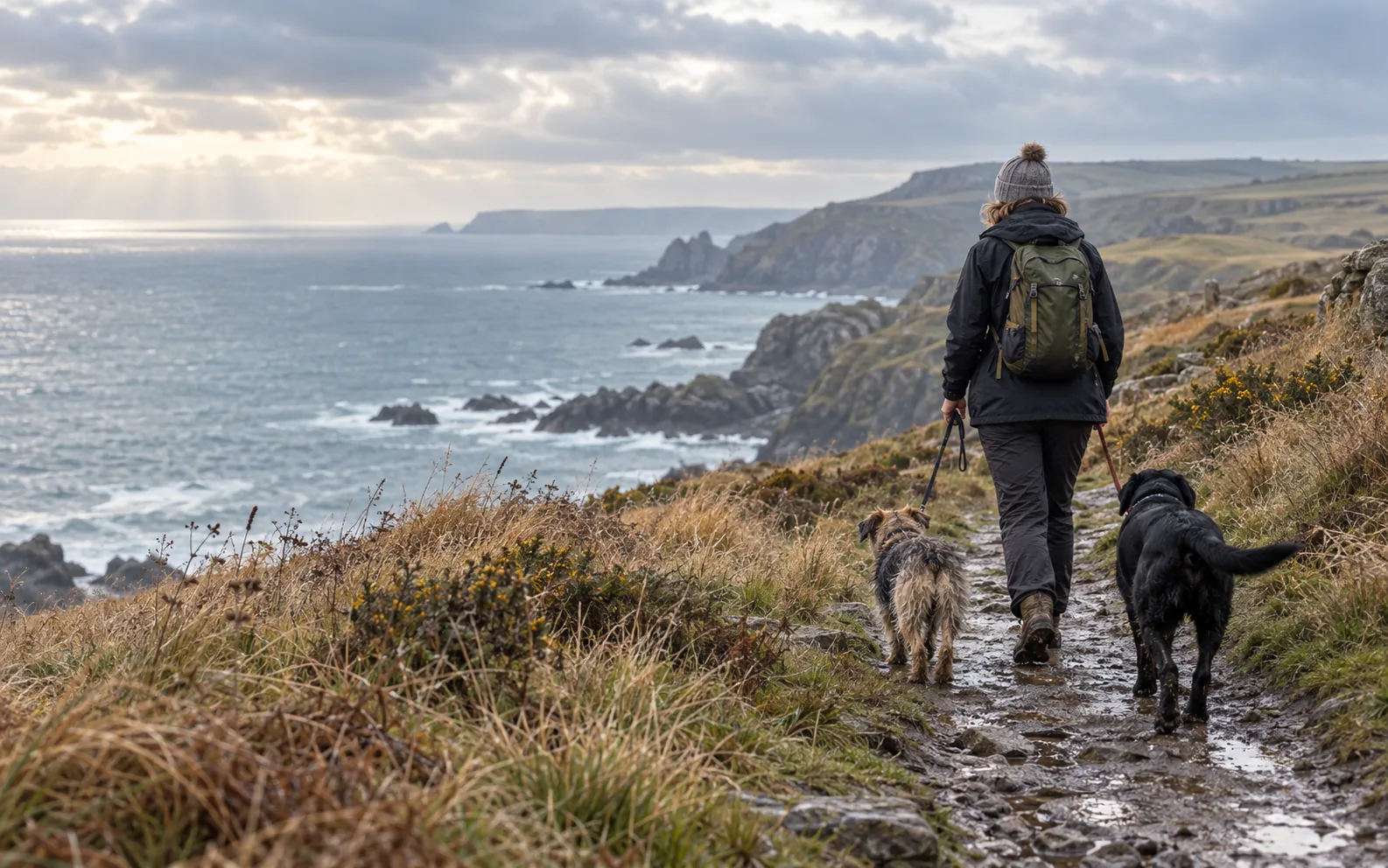
The coast path itself deserves a safety briefing. Sections have steep unfenced drops, and an excited dog lunging at a gull near a cliff edge is a genuine emergency. Walk dogs on a short lead or a long line on narrow cliff sections, and check tide times before beach walks — some coves cut off at high water. None of this should put you off; it should simply be planned for, like checking the weather.
Build a wet-weather version of the break
A dog-friendly pub is helpful, but it is not a whole fallback plan. Find a sheltered woodland walk, a short surfaced route and a place where you can eat outside under cover. Keep one afternoon deliberately unplanned; many dogs settle better after a quiet spell in the accommodation.
Devon’s rain is a when, not an if — and the county is well set up for it if you plan ahead. Woodland walks, such as the trails around Haldon Forest or the National Trust woods on the south coast, give you shelter and surfaced paths when the moor is a bog and the beach is horizontal rain. Identify one such walk near your park before you travel, plus one short hard-surface loop for the days when even the woods feel ambitious.
Eating out needs the same backup thinking. Many Devon pubs welcome dogs, but “dogs welcome” can mean the bar only, not the restaurant — and on a wet August evening the bar may be full. Check a couple of options in advance, including one with a covered terrace or a dog-friendly café for lunches. And protect the dog’s rest: a wet, tired dog that gets an afternoon dozing in a warm unit will walk better the next day than one dragged through a second downpour for the sake of the itinerary.
Quiet-season planning
Devon outside the school holidays is arguably the county at its best for dogs. Autumn brings empty beaches as seasonal restrictions lift, spring brings lambs and bluebells with fewer crowds, and winter brings bracing walks followed by pub fires — along with short days and the occasional named storm. Prices drop substantially, and the dog-friendly units that sell out in August sit empty in November.
Plan around what closes. Some parks shut entirely from November to March; others run year-round but with reduced facilities — the swimming pool, the restaurant or the entertainment complex may be seasonal even when the accommodation is open. Ask exactly what will be operating on your dates, and check heating arrangements and whether heating costs are included, because a cold snap in a poorly insulated unit is miserable for everyone and risky for older dogs.
Quiet season also changes the dog dynamics for the better. Beaches that ban dogs in summer often welcome them in winter; coast paths empty of crowds suit reactive dogs; and pubs that are standing-room-only in August have a fireside corner in February. The trade-off is daylight — plan walks for the middle of the day, carry a head torch for late toilet trips, and keep one eye on the forecast. A storm-day plan (woods, pub, rest) is as essential in January as a beach plan is in July.
Booking checks that matter here
Devon’s booking calendar has two speeds. Summer school-holiday weeks at coastal parks need booking six to nine months ahead, with dog-friendly units the first to go; shoulder and winter dates can often be booked a few weeks out, sometimes with late deals. Decide which trip you are taking before you start comparing prices, because a cheap February week and a peak August week are barely the same product.
Run the standard UK holiday park booking checks — per-dog charges, maximum dog numbers, boundary specifics, the after-dark toilet walk, eating-together options — and add Devon-specific questions: how exposed is the park in bad weather, what is the winter heating situation, and where is the nearest vet (rural practices can be a real drive). If moor walking is the point of the trip, ask the park about current livestock grazing nearby and tick prevalence; if the beach is the point, check the named beach’s restrictions for your exact dates, as Cornwall’s beach rules illustrate how much these vary across the South West.
Practical questions
Before you go
Can dogs walk freely on Dartmoor?
Access and lead requirements vary with livestock, nesting seasons and local signage. Sheep, cattle and ponies graze the open moor, and ground-nesting birds need undisturbed space from spring to midsummer. Follow current signs and official access guidance, and default to a lead whenever livestock are present.
Which Devon coast is better for dogs?
Neither is universally better. The north coast has big surf beaches but stricter seasonal restrictions and heavier summer crowds; the south coast is more sheltered with gentler walking but smaller beaches. Choose according to your dates, the restrictions in force, and how far you will happily drive each day.
Are ticks a problem on Devon walks?
They can be, especially on moorland, in long grass and around woodland edges. Check your dog after walks, carry a tick remover, and ask your vet about prevention before the trip if your dog picks them up easily. Prompt removal matters more than panic.
Will we find dog-friendly pubs easily?
Devon has plenty, but “dogs welcome” often means the bar rather than the restaurant, and popular spots fill on wet evenings. Identify two or three options near your park in advance, including one with a covered terrace, so a rainy day still ends well.
How far ahead should we book a Devon park?
For summer school-holiday weeks at coastal parks, six to nine months ahead — dog-friendly units sell first. Shoulder-season and winter breaks can often be booked a few weeks out, sometimes with late availability deals. Decide which season’s trip you want before comparing prices.